A Smart Guide to Types of Real Estate 2026 | AR Empires
AR Empires explains Different Types of Real Estate in Pakistan, including residential, commercial, industrial, & land properties, risks, facts, & useful tips.

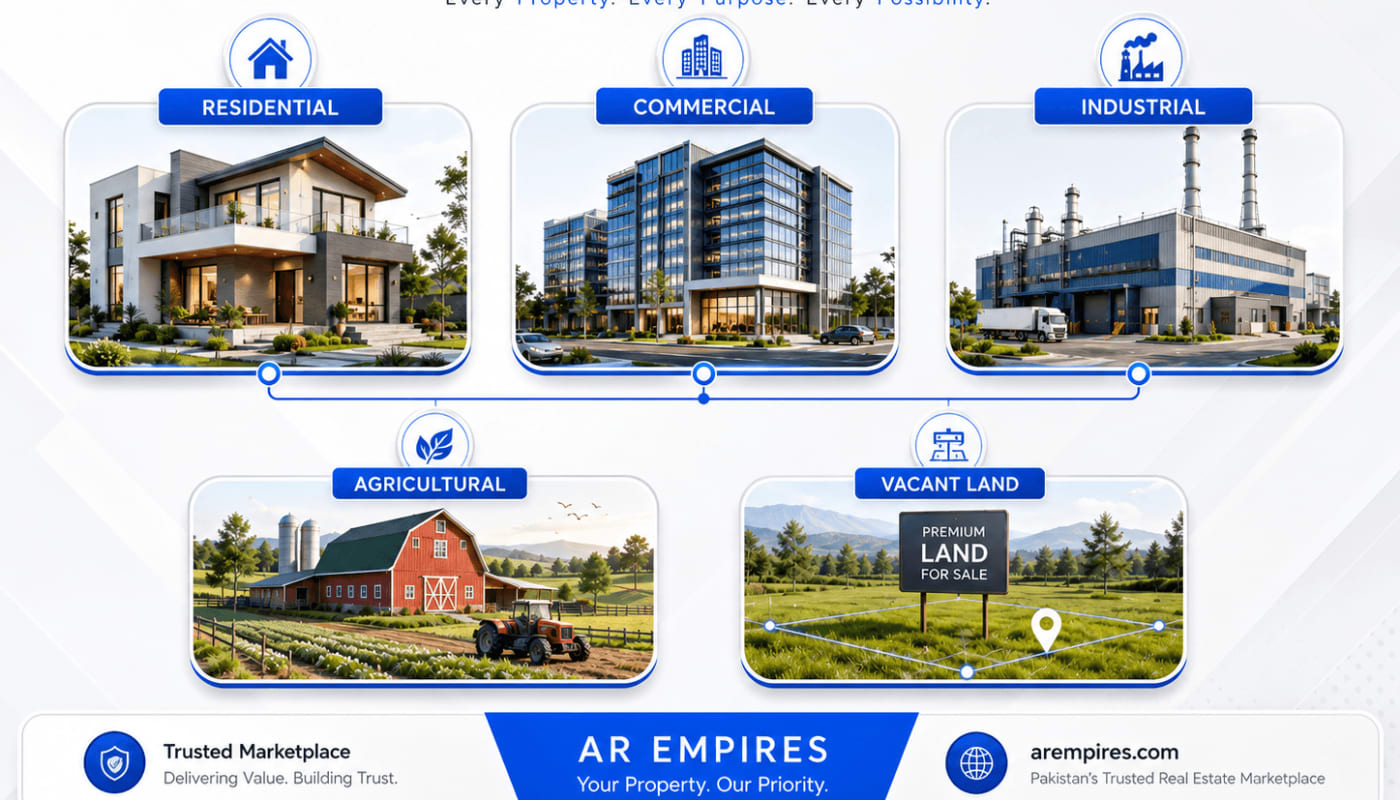
AR Empires: Different Types of Real Estate in Pakistan
AR Empires explains Different Types of Real Estate in Pakistan to help buyers, investors, and ordinary readers understand how the property market is divided. Real estate is not limited to houses and plots. It also includes commercial buildings, industrial facilities, agricultural land, warehouses, offices, shops, and mixed-use developments.
Pakistan’s 2023 Population and Housing Census recorded a national population of approximately 241.5 million. Islamabad Capital Territory alone had around 2.36 million residents. Population growth, urban expansion, business activity, and infrastructure development continue to create demand for different property categories.
However, demand does not make every property a safe investment. Each category has different legal requirements, operating costs, rental potential, and risks. Understanding the 4 types of real estate is therefore necessary before purchasing, renting, or developing property.
Different Types of Real Estate: Four Main Categories
Different Types of Real Estate in Pakistan can be divided into four main categories:
· Residential real estate
· Commercial real estate
· Industrial real estate
· Land
Each category serves a different purpose. Residential property provides housing, commercial property supports business activity, industrial property facilitates production and logistics, while land may be used for construction, agriculture, or future development.
The right property depends on the buyer’s objective. A family looking for a home has different requirements from an investor seeking rental income. Similarly, a business searching for a warehouse must consider factors that do not normally apply to an apartment or residential plot.
AR Empires: Residential Real Estate in Pakistan
AR Empires considers residential property the most familiar category among the Different Types of Real Estate. Residential real estate includes properties designed primarily for people to live in.
The main types of residential properties in Pakistan are:
· Houses
· Apartments and flats
· Residential plots
· Farmhouses
Houses
Independent houses are common in planned housing societies, urban neighbourhoods, and established residential sectors. They usually provide greater privacy, separate entrances, parking, and more freedom for renovation or expansion.
A house may be suitable for a family that plans to live in one location for several years. However, houses usually require more maintenance than apartments. The owner is responsible for structural repairs, security, plumbing, electrical work, exterior maintenance, and utility management.
Before buying a house, the buyer should inspect the building’s condition and verify that its construction follows the approved building plan. Cracks, water seepage, drainage problems, outdated wiring, and unauthorised extensions can create significant expenses after purchase.
Apartments and Flats
Apartments are becoming more relevant in major cities because they use land more efficiently than independent houses. They may provide facilities such as security, elevators, parking, backup electricity, shared maintenance, and recreational areas.
Apartments can be useful for small families, professionals, students, and investors seeking rental income. However, the quality of an apartment depends heavily on the building’s management.
Important factors include the building approval, completion certificate, fire-safety arrangements, elevator condition, water supply, parking rights, monthly service charges, and maintenance quality. A modern-looking apartment may still be a poor choice if the building has weak management or incomplete approvals.
Residential Plots
Residential plots are commonly purchased for future house construction or long-term holding. A plot gives the owner more control over design, construction quality, and the timing of development.
However, a plot normally produces no rental income until a house is constructed. Its value depends on legal possession, development status, road access, utilities, location, and construction regulations.
One of the most important real estate investing tips is to understand the difference between a physically available plot and a plot file. A file, allotment letter, or future ballot claim may not represent a developed plot with possession.
Buyers should confirm the plot number, dimensions, official map location, possession status, transfer procedure, outstanding charges, and availability of electricity, water, gas, and sewerage.
Farmhouses
Farmhouses are larger residential properties usually located outside densely populated urban areas. They may be used for personal residence, recreation, agriculture, or private gatherings.
Farmhouses generally require higher maintenance because of their size, security requirements, landscaping, water needs, and distance from urban services. Buyers must also verify whether the land is approved for residential, agricultural, or commercial use.
Using a farmhouse as an event venue or commercial facility may require additional permission. The buyer should not assume that every activity is permitted simply because the property is privately owned.
AR Empires: Commercial Real Estate in Pakistan
AR Empires defines commercial real estate as property used mainly for business, trade, professional services, or income-generating activities. Commercial property often provides higher rental income than residential property, but it may also involve greater vacancy risk and management requirements.
The main commercial property types are:
· Retail properties
· Office properties
· Hospitality properties
· Mixed-use buildings
Retail Properties
Retail properties include shops, showrooms, supermarkets, shopping-centre units, and street-facing outlets. Their performance depends largely on customer access and business activity in the surrounding area.
A small shop in a busy commercial market may produce better rental income than a larger shop in an undeveloped location. Size alone does not determine value.
Retail buyers should examine foot traffic, road visibility, frontage, parking, competition, nearby population, delivery access, and signage rights. Visiting the location at different times and on different days is one of the most practical real estate investing tips for evaluating retail property.
A shop that appears busy during one short visit may have weak activity during the rest of the week. Actual observation is more dependable than verbal claims about customer traffic.
Office Properties
Office properties include individual rooms, corporate suites, complete floors, clinics, coworking spaces, and business centres. Their demand is linked to accessibility, parking, building facilities, and the type of businesses operating nearby.
Office tenants generally prefer locations that are easy for employees and clients to reach. Reliable electricity, internet connectivity, elevators, security, fire exits, and professional building management also affect rental demand.
Islamabad real estate includes office activity in Blue Area, sector markaz areas, commercial centres, and developing business zones. However, Islamabad real estate should not be treated as one uniform market. Rental demand and property value vary according to sector, road access, parking, building age, maintenance, and legal status.
An office with limited parking or an unreliable elevator may struggle to retain tenants even when it is located in a recognised business district.
Hospitality Properties
Hospitality properties include hotels, guest houses, serviced apartments, restaurants, and event venues. These properties depend on active operations rather than passive ownership alone.
Their performance is affected by location, occupancy, customer service, operating licences, staff costs, maintenance, online reviews, and competition. A hotel or guest house may generate strong revenue, but it also requires daily management and continuous operating expenses.
Before purchasing hospitality property, buyers should verify approved use, fire-safety compliance, parking, kitchen and drainage systems, utility capacity, and local licensing requirements.
Mixed-Use Buildings
Mixed-use properties combine more than one function within the same development. A building may contain shops on the ground floor, offices on the middle floors, and apartments on the upper floors.
This model can create income from several tenant categories. It can also reduce dependence on a single use. However, mixed-use buildings require clear management of entrances, parking, elevators, utilities, security, and common spaces.
Buyers should confirm that all uses inside the building are officially approved. A property advertised as mixed-use may not necessarily have legal approval for every activity being conducted there.
Different Types of Real Estate: Industrial Property
Different Types of Real Estate also include industrial property, which is used for manufacturing, storage, processing, and distribution. Industrial real estate is less familiar to ordinary homebuyers, but it plays a major role in the economy and supply chain.
The main industrial property types include:
· Factories and manufacturing units
· Warehouses
· Distribution and logistics centres
· Cold-storage facilities
Factories and Manufacturing Units
Factories are designed for manufacturing, assembly, processing, or production. Their requirements depend on the type of industry operating inside them.
A manufacturing facility may need high-capacity electricity, gas, ventilation, drainage, waste disposal, fire protection, worker access, and heavy-vehicle entry. The property must also be located in an area where the intended industrial activity is legally permitted.
One of the most important real estate investing tips for industrial property is to confirm zoning before purchase. A building may appear suitable for manufacturing but may not have approved industrial use.
Environmental regulations, noise restrictions, waste management, and worker-safety requirements must also be considered.
Warehouses
Warehouses are used for storing goods, equipment, raw materials, and finished products. Demand for warehouse space is influenced by wholesale trade, retail distribution, manufacturing, construction, and e-commerce.
A useful warehouse requires more than a large covered area. It should have suitable ceiling height, loading space, truck access, ventilation, security, drainage, and fire-protection systems.
The internal layout should match the goods being stored. Food, medicine, chemicals, electronics, and construction materials all have different storage requirements.
Logistics and Distribution Centres
Distribution centres are designed for the quick movement of goods rather than long-term storage. They require efficient road connections, loading bays, vehicle circulation, and access to major urban markets.
Properties near motorways, ring roads, industrial estates, and transport corridors may be suitable for logistics operations. However, buyers should also consider traffic restrictions, road width, distance from customers, fuel costs, and delivery times.
Cold-Storage Facilities
Cold-storage properties are specialised industrial facilities used for food, medicine, agriculture, and other temperature-sensitive products.
These facilities require reliable electricity, backup generators, insulation, refrigeration systems, temperature monitoring, drainage, and technical maintenance. Because they are specialised, their operating and repair costs may be higher than those of ordinary warehouses.
AR Empires: Land as a Real Estate Category
AR Empires includes land among the 4 types of real estate because it may be purchased for construction, agriculture, commercial development, industrial use, or long-term holding.
The main land categories include residential land, commercial land, industrial land, agricultural land, and undeveloped land.
Agricultural land is used for crops, orchards, livestock, or farming operations. Its value depends on water availability, soil quality, road access, location, and permitted land use.
Undeveloped or raw land may not have proper roads, utilities, sewerage, or official development. It may offer long-term potential, but it also carries significant uncertainty.
Before buying land, the purchaser should verify:
· Legal ownership and title
· Exact boundaries and measurements
· Physical possession
· Approved land use
· Legal access road
· Development or acquisition notices
· Transfer restrictions
· Availability of infrastructure
Land should not be purchased solely based on brochures, future maps, verbal promises, or claims of guaranteed appreciation.
Different Types of Real Estate: Due Diligence
Different Types of Real Estate carry different risks, but the basic due diligence process remains similar. Buyers should verify ownership, legal status, physical condition, approved use, total cost, and future demand.
Before completing a transaction, confirm that the seller has the legal authority to sell. Official records should be checked for mortgages, disputes, unpaid dues, inheritance claims, and transfer restrictions.
The physical property should also be inspected. Houses and commercial buildings may require an engineering inspection, while plots and land should be measured and matched with official records.
For income-producing property, calculate the net return after deducting:
· Vacancy periods
· Maintenance and repairs
· Service charges
· Property-management costs
· Taxes and transfer expenses
· Financing costs
A property with high advertised rent may still generate a weak return if it remains vacant or requires frequent repairs.
AR Empires: Islamabad Real Estate Considerations
AR Empires gives particular attention to Islamabad real estate because the capital contains planned sectors, government institutions, universities, diplomatic activity, corporate offices, and growing residential areas.
The 2023 census recorded approximately 2.36 million residents in the Islamabad Capital Territory. It also reported an average annual population growth rate of about 2.81% between 2017 and 2023.
This growth can support demand for housing, offices, shops, and services. However, buyers must still verify the authority responsible for the project, the approved layout plan, the no-objection certificate where required, the possession status, the utility availability, and construction rules.
Islamabad real estate varies substantially between established sectors, developing areas, private housing schemes, and peripheral locations. Two properties advertised under the Islamabad real estate market may have completely different legal status, infrastructure, and accessibility.
Different Types of Real Estate: Final Considerations
Different Types of Real Estate should be selected according to purpose rather than market rumours.
A family seeking a home may prefer a completed house or apartment. An investor seeking rental income may consider a shop, office, or apartment with proven tenant demand. A business may require a warehouse, retail outlet, or industrial unit based on operational needs. A long-term investor may consider land, but must be prepared for uncertain development timelines.
Pakistan’s draft National Housing Policy 2025 refers to a housing deficit of approximately nine million units. World Bank data also indicates that around 38.36% of Pakistan’s population lived in urban areas in 2024.
These figures show the scale of Pakistan’s housing and urban-development needs. They do not mean that every project is legally approved, fairly priced, or likely to generate profit.
AR Empires concludes that the most dependable real estate investing tips are to verify documents, inspect the property, confirm approved use, calculate total costs, study actual local demand, and avoid decisions based on unsupported promises.
Understanding the 4 types of real estate—residential, commercial, industrial, and land—allows buyers to compare properties according to their actual purpose, financial capacity, expected income, and level of risk.